 World Stroke Organization
 The Paper of The Month – January
19 Jan 2026Vascular Dementia in 2026: Why Stroke Systems Must Promote Brain Health
Vascular Dementia in 2026: Why Stroke Systems Must Promote Brain Health
Prof. Octavio Marques Pontes-Neto, MD, PhD – Editor-in-Chief, World Stroke Academy
This article is a commentary on the following: Cai Y, Mok VCT, Markus HS. Vascular dementia: World Stroke Organization fact sheet 2026. International Journal of Stroke. 2026;0(0). doi:10.1177/17474930251404243
Commentary:
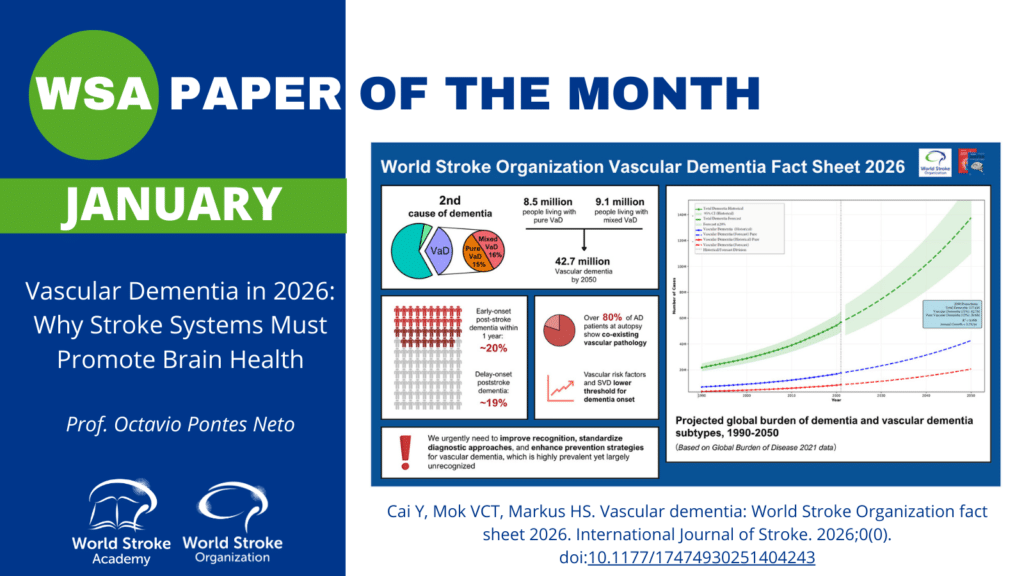
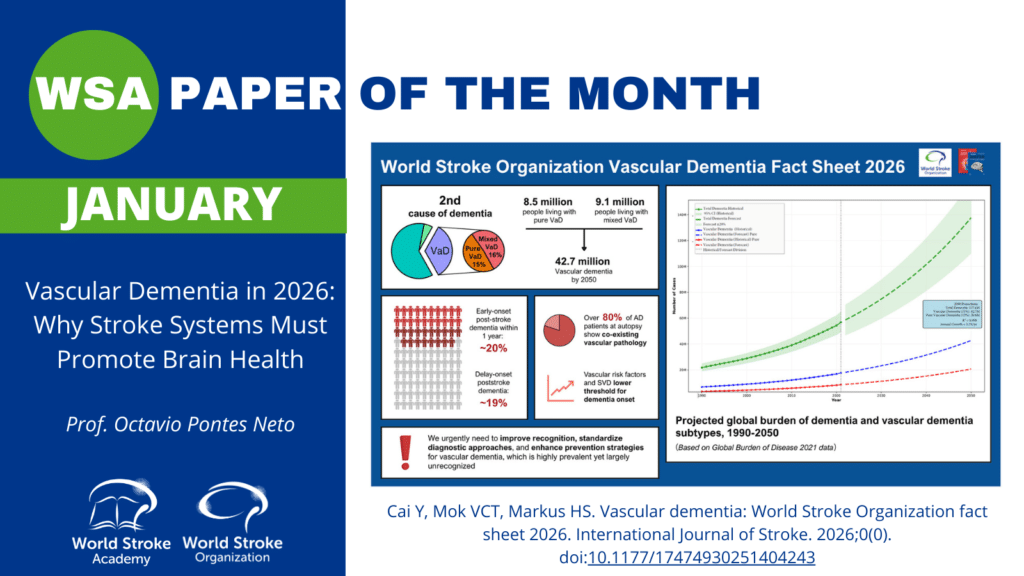
Vascular dementia (VaD) is often labeled as the “second most common” dementia subtype, but this shorthand hides what the 2026 World Stroke Organization fact sheet makes unmistakably clear: vascular injury is not merely a competing diagnosis; it is a major driver of the global dementia burden, frequently co-existing with Alzheimer’s pathology and shaping prognosis after stroke.1 The fact sheet recently published in the Internationial Journal of Stroke frames VaD as a clinical and public-health priority, anchored in the reality that dementia prevalence is rising worldwide and that cerebrovascular disease will increasingly determine who develops cognitive impairment, how early it appears, and how preventable it may be.
A central contribution of this document is its emphasis on mixed disease. Autopsy and clinicoradiologic data consistently show that “pure” VaD is only part of the story, while mixed vascular and neurodegenerative pathology is common, meaning that vascular mechanisms contribute to a substantial proportion of dementia presentations seen in practice. This is not an academic distinction: mixed pathology is exactly where aggressive vascular prevention, stroke prevention, and secondary prevention can plausibly change trajectories, even when neurodegenerative processes are present. The fact sheet also highlights the persistent heterogeneity in diagnostic approaches across studies (population-based versus clinic-based, clinical versus imaging-supported definitions), which continues to produce variable prevalence estimates and complicates comparisons across regions and health systems.
From a stroke clinician’s perspective, the most actionable message is the prominence of post-stroke dementia. The fact sheet reinforces that cognitive decline after stroke is common and can occur early or later, with differing mechanisms and implications for prevention and rehabilitation. It also underlines how often vascular cognitive impairment is under-recognized in routine care, particularly when attention is focused on motor recovery and recurrent stroke prevention, despite its profound impact on quality of life, caregiver burden, adherence to secondary prevention, and long-term institutionalization risk. In other words, “good stroke care” is incomplete if it stops at functional independence and neglects cognition.
The statement is equally clear about what we can do now. The strongest near-term opportunity remains prevention: rigorous control of blood pressure, diabetes, and lipids; smoking cessation; physical activity; and evidence-based acute stroke care and secondary prevention, because each of these reduces both recurrent vascular events and downstream cognitive injury. Importantly, the fact sheet positions dementia prevention as an extension of established vascular prevention, making the case that stroke pathways, primary care, and public-health strategies should be explicitly designed to protect long-term brain function, not only to avert recurrent events.
Finally, the fact sheet points to an urgent research and implementation agenda: harmonizing definitions and outcomes for vascular cognitive impairment and VaD; clarifying the contribution of small-vessel disease, microinfarcts, and mixed pathology across populations; developing scalable models for cognitive screening and follow-up after stroke; and testing interventions that target patients at highest risk of decline. For the World Stroke Academy community, the take-home message is straightforward: vascular dementia is not a niche diagnosis; it is the cognitive face of cerebrovascular disease. If stroke systems embrace cognition as a core outcome, we can move from describing the burden to measurably reducing it.
References:
Cai Y, Mok VCT, Markus HS. Vascular dementia: World Stroke Organization fact sheet 2026. Int J Stroke. 2026 Jan 1:17474930251404243. doi: 10.1177/17474930251404243. Epub ahead of print. PMID: 41479247.
 ;
;